


Introduction
Building Resilience: Practical Guidelines for the Retrofit and Rehabilitation of Buildings in Canada serves as a “sustainable building toolkit” that will enhance understanding of the environmental benefits of heritage conservation and of the strong interrelationship between natural and built heritage conservation. Intended as a useful set of best practices, the guidelines in Building Resilience can be applied to existing and traditionally constructed buildings as well as formally recognized heritage places.
These guidelines are primarily aimed at assisting designers, owners, and builders in providing existing buildings with increased levels of sustainability while protecting character-defining elements and, thus, their heritage value. The guidelines are also intended for a broader audience of architects, building developers, owners, custodians and managers, contractors, crafts and trades people, energy advisers and sustainability specialists, engineers, heritage professionals, and officials responsible for built heritage and the existing built environment at all jurisdictional levels.
Building Resilience is not meant to provide case-specific advice. It is intended to provide guidance with some measure of flexibility, acknowledging the difficulty of evaluating the impact of every scenario and the realities of projects where buildings may contain inherently sustainable elements but limited or no heritage value. All interventions must be evaluated based on their unique context, on a case-by-case basis, by experts equipped with the necessary knowledge and experience to ensure a balanced consideration of heritage value and sustainable rehabilitation measures.
Building Resilience can be read as a stand-alone document, but it may also further illustrate and build on the sustainability considerations in the Standards and Guidelines for the Conservation of Historic Places in Canada (Federal Provincial Territorial Historic Places Collaboration (FPTHPC), Second Edition, 2010). Refer to link.
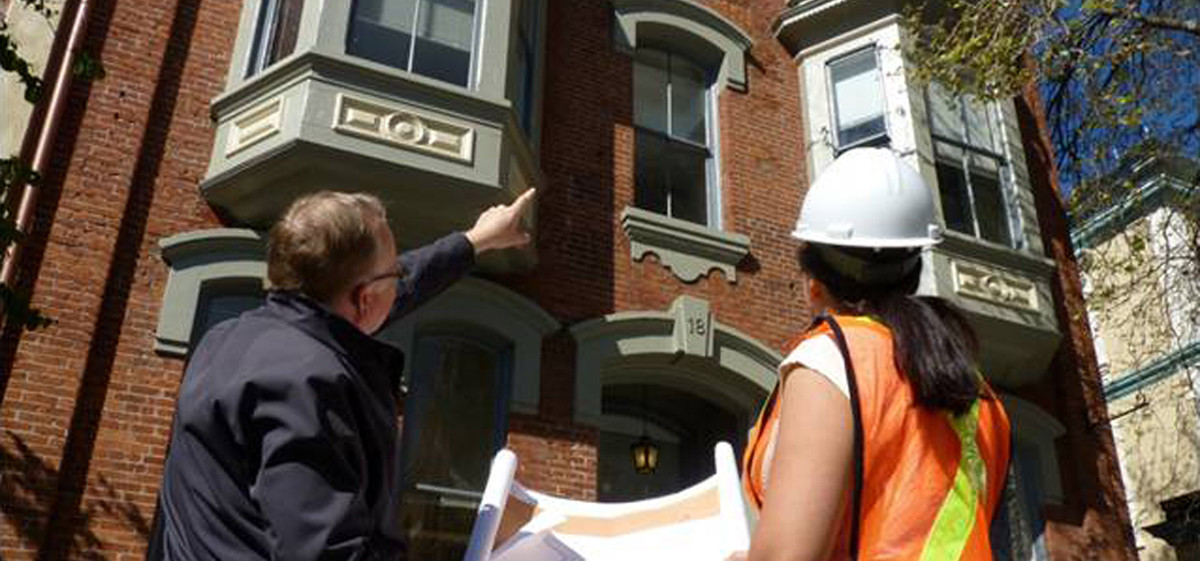
Reviewing sustainability upgrade opportunities and inherently sustainable elements on site. Source: Judith Cook
Guidelines at a Glance
PART ONE (Introduction) provides background and context around issues related to the sustainable retrofit and rehabilitation of buildings. It defines the terms and helps us understand why sustainable retrofit and rehabilitation is useful and important, how it relates to the wider world, who should be involved in building conservation, and how Building Resilience can be used as a companion to the Standards and Guidelines for the Conservation of Historic Places in Canada.
PART TWO delves more deeply into issues surrounding sustainable retrofit and rehabilitation, placing emphasis on the fundamental need to properly and thoroughly understand the existing building prior to undertaking retrofit or rehabilitation work, particularly the building’s history, cultural heritage value, fabric, changes of form, and use over time. Part Two also provides information on some broader related issues such as the building site’s wider context and the retrofit or rehabilitation of buildings from the Modern period.
PART THREE provides practical tested guidance, broken out by building components to simplify the approach to building retrofit and rehabilitation. It also looks at building materials and maintenance as they relate to sustainable retrofit and rehabilitation. Use Part Three for direct assistance in planning, designing, and executing a retrofit or rehabilitation project.
PART FOUR offers further information, including a bibliography and resource list, information on web-based design tools, a glossary, and Appendices, including case studies.